
Replaced.
47 jobs AI will replace. And the psychology of who survives.

The AI Paradox:
AI will create more jobs than it replaces.
We need more humans, so we can use AI more.
Aaron Levie (CEO of Box) nailed it.
AI doesn’t reduce demand for knowledge work.
It explodes it.
Just like better steam engines led to more coal consumption (the famous Jevons Paradox, 1865).

We made cars more efficient, using less fuel.
As a result, more people were using cars, so we consumed much more fuel.
Cheaper/more efficient cognition → companies do way more projects, experiments, personalization, long-tail ideas that were once too expensive.
Result: More white-collar work overall. More innovation. More growth.
It’s a mind-shift you must adopt (or truly be left behind).
Stop thinking: “How to replace 5 members of my team with AI?”.
Start thinking: “How can 5 members of my team do the work of 50 with AI?”
And it starts with you.
You must duplicate yourself.
1. How I duplicated myself.
I started being obsessed with AI in November 2022.
The dream: I didn’t have to hire; I could just do better, faster.
So I trained AI to do more + better.
And I am able to do more & better.
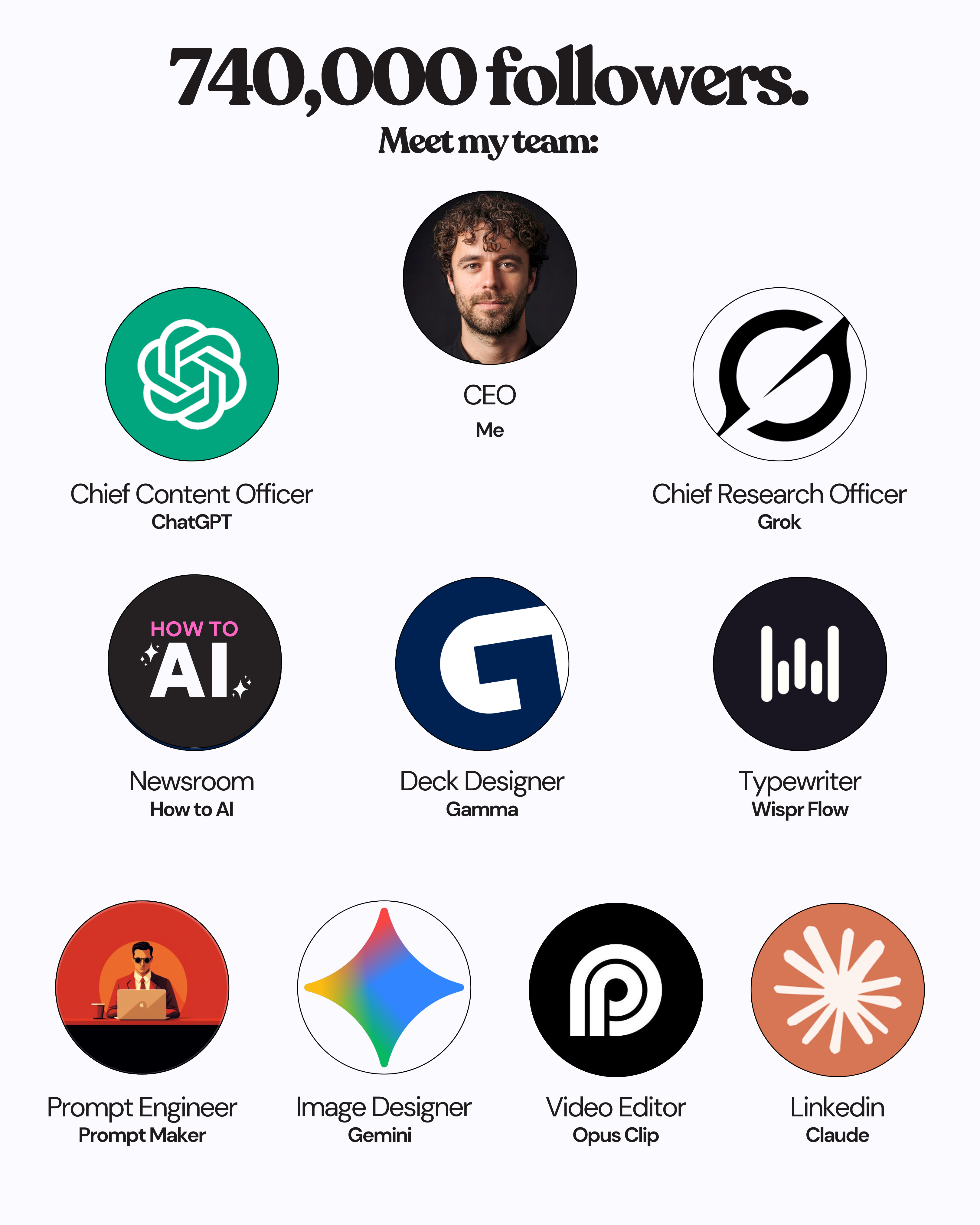
✦ ChatGPT to analyze my content.
I upload my best/worst posts with this prompt:
Act like a world-class LinkedIn content strategist and growth analyst.
Objective: Turn the user’s uploaded “best” and “worst” LinkedIn posts (text/screenshots + any metrics) into a repeatable, personalized playbook. Keep the work lightweight by operating in phases, not all at once.
How to work:
- If metrics are provided, use them. If not, infer cautiously and label assumptions.
- Quote or reference exact lines/sections when you explain performance.
- Be blunt and specific (no generic advice).
PHASE 1 — Diagnosis (deliver this first, then stop and ask questions)
1) Rapid patterns (max 7 bullets): what winners share, what losers share, 3 do-more, 3 stop.
2) Post audit (for each post, max 10 lines):
- Winner/Loser verdict + 2–4 reasons tied to specific lines
- Keep / Change / Remove (bullets)
- One “biggest lever” to improve it
3) Winner DNA: a short checklist of repeatable ingredients (max 8 items).
PHASE 2 — Execution plan (only after the user answers your questions)
4) Double-down: 6 next-post concepts in the user’s voice; each includes 2 hook options + a 5-bullet outline + CTA.
5) Repurpose: pick the top 2 winners and generate 2 repurpose angles each (choose: story, contrarian take, framework, case study) with mini-outlines.
Collaboration (end PHASE 1 with questions):
Ask 6 targeted questions to tailor PHASE 2 (ideal audience, goal, offer/CTA, voice boundaries, proof assets, cadence). Then propose 2 A/B tests and ask the user to pick one to run next.
Take a deep breath and work on this problem step-by-step.
✦ Grok to search.
I will write an entire newsletter on it.
Grok is slowly replacing all of my LLMs (ChatGPT, Claude…).
✦ Gamma for carousels/ decks.
✦ Wispr Flow to write as I talk (literally).
✦ Prompt Maker to create prompts, quickly.
✦ Gemini for images, Opus Clip to edit videos, Claude to write.
That’s all cool and game. But I am limited to working 8 (true) hours per day.
Even if AI makes me 10x more efficient, I can’t have 10x more hours.
I had to hire more people. So they can use AI for me.
Archive: https://docs.google.com/document/d/1pWuMCBVQo1zKcgKltX_BZxAr31KgxmOlp3Vzvmc5Hxc/edit?usp=sharing.
2. You need more people.
And I did it. I hired more.
Anisha, Axelle, Zane, Rica, and three (different) agencies.
We run “How to AI” – newsletter, content, and support.
I partnered with Pete on the consulting side (to support Fortune 500 businesses in the US to transition to actually using AI to be better).
Without AI, I’d still be solo (or maybe 2 people max).
With AI? We handle 100x more: more client workshops, more curated content, more case studies, more research, more of everything, really.
Efficiency created massive new demand.
I need more humans to leverage it fully.
No shortcuts. No “AI replaced this guy.”
Just pure scaling faster.
It’s addictive.
Here’s how to start:
A. Master one AI win TODAY (exact example included).
Wrong: Wait for “perfect” AI.
Right: 10x one real task now.
Let’s take an example with searching for the right info, whatever is your field.
Steps:
Pick research (common bottleneck).
Go to Grok (or Claude/Gemini). I prefer Grok.
Paste this exact prompt by replacing [topic] & [audience]:
Act like are a world-class researcher in front of a [audience]. Summarize the latest 2025-2026 trends on [topic] in bullet points: key stats, 3 emerging tools, 2 risks, 1 opportunity for consultants. Sources only from reputable sites (McKinsey, Gartner, a16z).
Run it until it the result matches your usual research.
Now teach someone how to run this every day & what to do with it.
B. How to teach someone to use AI for you.
Let me give you an example first.
I ask my team to go here to fetch the latest AI articles on arXiv:
They must go here.
Go to Grok, copy and paste the entire list (= 300 articles).
They paste this exact prompt:
You are an expert in identifying viral AI content for non-technical audiences.
I will provide you with a list of up to 300 recent arXiv papers from the cs.AI category, each with title, arXiv ID, and abstract.
Your task: read all of them and select exactly ONE paper that has the highest potential to go viral on social media (Twitter/X, Reddit, TikTok, YouTube) when summarized for non-technical people.
The paper must help everyday readers better understand how Large Language Models (LLMs) actually work, their limitations, capabilities, or surprising behaviors — in an accessible, relatable way without heavy math or jargon.
Evaluation criteria (rank by these, in order):
1. Title is catchy, provocative, or curiosity-inducing for general public.
2. Core insight is surprising, counterintuitive, or myth-busting about LLMs.
3. Concept can be explained in simple analogies or real-world examples.
4. Finding is timely, relatable, or emotionally resonant (e.g., trust, creativity, intelligence).
5. Avoids dense technical details; focuses on implications for people.
Output format:
- Title and arXiv ID
- One-sentence viral hook (how it would be phrased in a social media post)
- 3-bullet explanation of why this specific paper is the most viral candidate
- Do not select any other paper or add extras.
But to get there, I had to brief them.
That’s how I do it:
I create a Loom/Screen Studio video of me actually doing it. They will go back to this video anytime they need to see me doing it in action. That’s why I think it must be top-down: C-levels first (that’s how I consult businesses).
I then create a written doc (google doc, Notion…) with the Standard procedure.
I made a prompt to create it faster:
Act like a senior SOP architect, AI enablement lead, and instructional designer.
Your goal is to help me create a clear, practical SOP that teaches a new employee how to use AI safely and effectively in my business. You will do this by asking me the right questions first, then turning my answers into an SOP.
Task (phase 1): Ask me only questions (no SOP yet). Make the questions specific enough that, once answered, you can produce a complete SOP with minimal assumptions.
How to ask:
- Ask 15–20 questions total, grouped into 5 sections.
- Questions must be short, unambiguous, and action-oriented.
- Prefer multiple-choice or “fill in the blank” when possible.
- If you must assume something, don’t—ask a question instead.
- After the questions, include a compact checklist of what you still need (if anything).
Sections to cover (ask questions in this order):
1) Company + role context: team, employee role, responsibilities, success metrics.
2) AI usage scope: top 10 tasks AI should help with, and tasks AI must never do.
3) Tools + access: which AI tools, accounts, integrations, devices, permissions.
4) Quality + workflow: how prompts are written, review/approval steps, how to verify outputs, examples of “good vs bad”.
5) Safety + policy: confidentiality rules, PII/client data handling, copyright, hallucinations, escalation path, logging/documentation expectations.
Task (phase 2): Only after I answer, produce:
- A 1-page SOP summary
- A detailed SOP (step-by-step)
- A training plan for the first week
Take a deep breath and work on this problem step-by-step.
C. Hire for psychology, not technical genius.
Wrong: Look for “AI experts” with degrees/certifications.
Right: Hire humans who thrive in chaos. Humility to admit AI is better (or really, really bad) sometimes, resilience to iterate 10x/day, fast learning/pivoting, zero tolerance for average output, taste to steer AI toward excellence.
The psychologically behind it (I love Carl Jung, stay with me):
- High “openness to experience” (Big Five) + Jungian “individuation” mindset: they confront their shadow (ego, fear of obsolescence) and integrate AI as a tool for self-actualization.
- MBTI preference: Intuitive-Perceiving types (NxPx – ENTP, INTP, ENFP, INFP) dominate my team. They explore possibilities endlessly, adapt prompts on the fly, hate rigid structure.
- Refuse Judging/ Sensing dominance – too slow to pivot in AI’s fast chaos.
Steps to hire your first AI employee:
1. Job post add: “Must love experimenting, fail fast, learn faster. No ego. Taste required.”
2. Test task: Give bad prompt + mediocre output. Ask: “Make this 10x better in 3 iterations.” Watch humility/resilience.
3. Interview question: “Tell me about a time AI made you feel obsolete – how did you respond?”
4. Red flag: Brags about “knowing AI” vs. “excited to discover daily.”
5. Green flag: Shows personal projects, refined prompts, beautiful outputs.
You’ll keep needing more of them. They are the ones who will remain ahead.
(Companies: I train exactly these profiles in consulting.)
3. AI will create jobs… but still kill these jobs.
This will be controversial. But I’ll say it anyway.
Yes, AI will destroy tons of jobs. And some well-paid ones.
My (non-exhaustive) list, without holding back: