
🦥 Slow.
You live in the super-intelligence era. So why do you feel so (awfully) slow?

You live in the super-intelligence era.
So why do you feel so awfully slow?
January Broke You (& You Didn’t Even Notice)
Just 31 days from January, 2026.
Here’s a small glimpse of some AI news that happened in 31 days.
Anthropic releases Claude Cowork. Google launches Project Genie: real-time interactive 3D worlds generated from text. OpenAI teases GPT-5.3 “Garlic.” Rumors explode about Claude Sonnet 5 “Fennec.” 50% cheaper than Opus 4.5. Over a million tokens of context. But also a new Claude Opus 4.6. While xAI drops Grok Imagine 1.0. And on top raises $20 billion. Actually, SpaceX merges with xAI (it’s now a $1.25 trillion entity. The most valuable private company on Earth. Oh, and Anthropic closes above $10 billion at a $350 billion valuation. OpenAI is in talks for $100 billion more at a valuation pushing $800 billion. Gemini 3 is now the default for Google search. New Chinese Kimi 2.5 is live. Claude Excel disrupts industries so badly that software companies are free-falling. Claude then dropped financial ‘plugins’ on top. Is this how AGI feels?
That’s January. One month of 2026.
Now here’s your reality.
You open the same ChatGPT tab this morning. You type a prompt you’ve typed before. You get the “OK” answer you always get for this specific use case. You sometimes wonder if you're using ChatGPT correctly. Probably not.
Then you read about all of these news. Billions. Intelligence. Is there more to AI?
You saw the funding rounds. You felt a mix of excitement and dread. Mostly dread. All of this money spent to replace me? What should I (or my kids) even do?
You’re not keeping up. You know it. There is a gap between what’s happening out there & what’s happening in your actual day-to-day life. And the gap is widening.
And it’s crushing you.
Behind. Pressured. Overwhelmed. You’re never fast enough. Uncertain about your job. Uncertain about your kids’ future. Uncertain if this is something you can actually figure out, or if the train already left. No one seems to come to save you.
Why are you so slow when AI is so fast?
I can tell you: the feeling is right, the question is wrong.
You’re measuring the wrong speed.
You’re Measuring The Wrong Speed
You’re comparing yourself to the wrong thing.
Let me show you.
The iPhone launched in 2007. The App Store in 2008. Developers started building apps immediately. But when did your parents actually start using smartphones daily? 2012. Maybe 2014. That’s 5 to 7 years from technology to mass adoption.
The first web browsers appeared in 1993. Amazon launched in 1995. Google in 1998. But when did the average person go online for everything? Mid-2000s. That’s over a decade from technology to adoption.
This pattern repeats. Always. Technology moves first. Applications follow. Adoption crawls behind.
Now look at AI.
GPT-2 to GPT-4 happened in three years. Midjourney went from “huh, it generates weird hands” to ad-quality pixel-perfect images in three years. The technology is genuinely moving faster than anything before it. Historical speed.
But technology speed is not application speed. Application speed is not adoption speed. These are three different clocks.
Clock one: technology. New models weekly. Billion-dollar funding rounds. Research breakthroughs announced on Twitter before the paper is even published. This clock moves in days.
Clock two: applications. The tools you actually use. They take months to mature. Most of them are still half-baked. The interfaces are clunky. The workflows are messy. The documentation is incomplete. This clock moves in months.
Clock three: adoption. What normal people actually do. Most people still don’t use AI daily. Or they use it badly. One chat window. No context. No memory. No system. This clock moves in years.
You’re watching clock one. The news. The funding. The model releases.
But you’re living on clock three. The adoption curve. Where change happens slowly, awkwardly, and with a lot of drawbacks.
Like comparing how fast you’re learning piano to how fast Spotify adds new songs. Not only are you measuring speed wrong, but your brain also protects you.
Your Brain Protects You (& that’s the problem)
Knowing the measurement is wrong doesn’t fix the feeling. Like saying “You’re stressed, stop” to someone who’s stressed. Your feeling is biological, not logical.
Let me explain what’s happening inside your head.
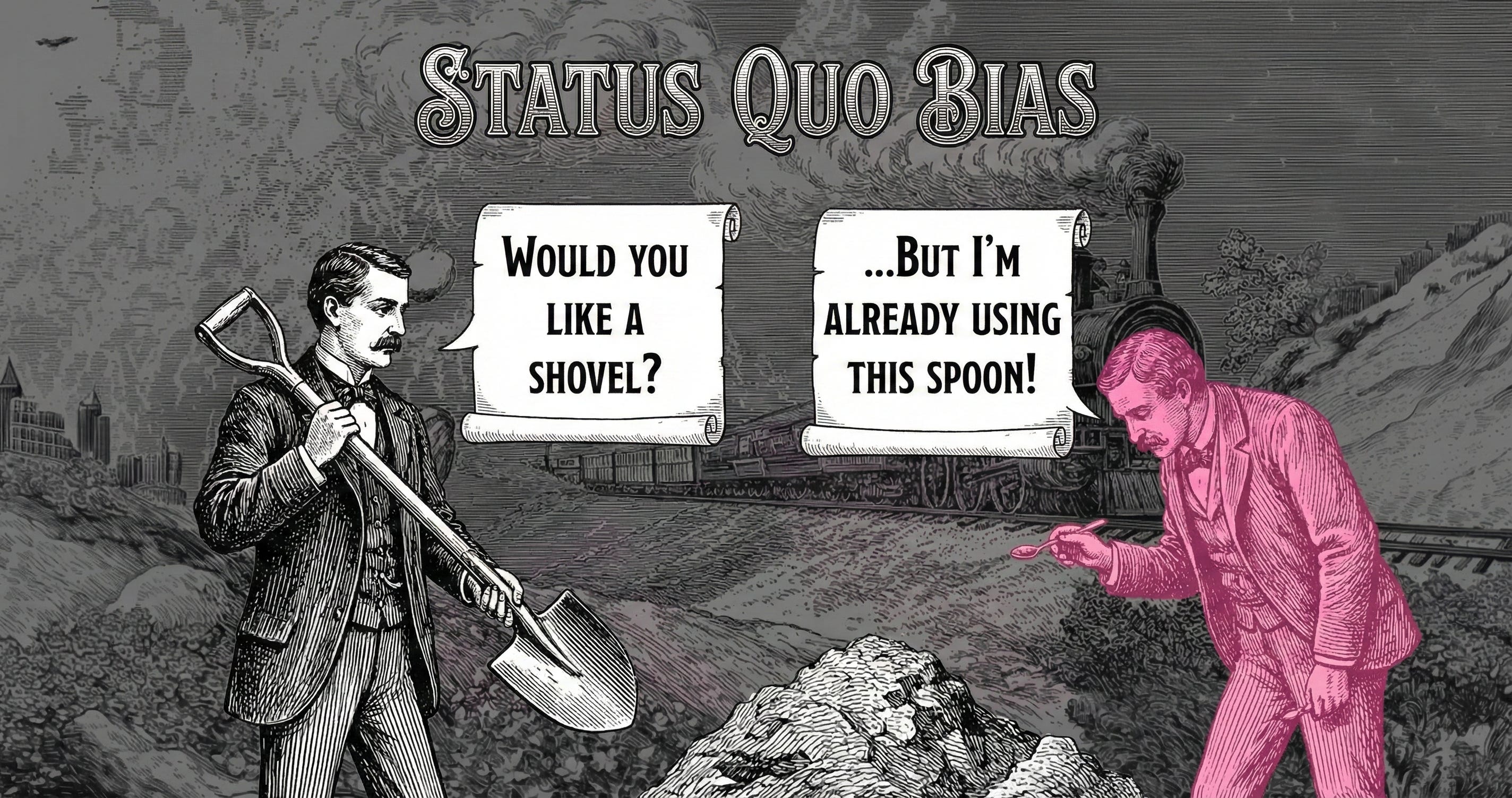
Status quo bias. Your brain has a built-in preference for the current state. Whatever is now is great. You don’t want it to change. Even when change would benefit you. Studies show people stick with default options 70 to 90% of the time. The default isn’t better. But switching requires energy. And your brain is an energy saver. You want to keep what you know. You’re in power-saving mode.
A million years of evolution taught your brain that unfamiliar = risky and familiar = safe. Served you well on the savanna. Destroying you in the high-speed AI era.
Cognitive load theory. Your brain has limited processing capacity. Think of it like RAM. You consume too much news — 47 new tools, daily releases, conflicting advice, hype mixed with fear — your RAM maxes out. And when it maxes out, your brain does something predictable: it defaults to what it already knows.
The flood of AI news is literally freezing your brain. More information = more paralysis = less action. Overloaded brains choose the safe path: do nothing new.
The adoption curve. A researcher named Everett Rogers mapped the spread of innovations. Only 2.5% of people are true early adopters (the ones who try new things before anyone else). The next 13.5% are early majority. The remaining 84% wait. They wait until the change is too obvious to avoid.
If you feel behind, you’re probably in that 84%. So… that’s statistically normal. Not broken. Just average. (The question is whether you want to stay there.)
Your brain protection mechanism is trapping you into a mix of decision paralysis and constant FOMO. Traps you build yourself. Here’s how to get out now:
The 4 Traps Keeping You Painfully Stuck
Four behaviors. Four traps.
You’re probably caught in at least two of them.
Trap 1: The Permission Loop
You were trained your whole career to ask first. Get buy-in. Align stakeholders. Socialize the idea. Make sure everyone’s comfortable before you move.
That made sense when building something took months. When mistakes were expensive. When resources were scarce & approval protected you from waste.
That world is gone.
Now you can build a working prototype in two hours. A rough draft in twenty minutes. A proof of concept before lunch.
But you’re still scheduling the meeting. The meeting to discuss whether to build it. The meeting to align on the approach. The meeting to get feedback on the plan for the meeting.
The meeting takes longer than the thing.
The old rule was: don’t waste resources without approval. The new rule is: don’t waste time getting approval for things you can just show. Build the thing. Show the thing. Then have the meeting — with the thing in front of everyone.
The permission loop is dead.
Show, don’t ask.
Trap 2: The News Addiction
You read the announcement about Claude Cowork. You felt informed. Productive, even. Monitoring the situation. You’re definitely staying in the loop. You’re not falling behind. Except you’ve never actually tried it.
You know it exists. You might even be able to explain what it does. But you’ve never opened it. Never tried it. Never let it touch your actual day-to-day.
→ You know about 200 tools.
→ You use maybe two.
→ And you use those two badly.
But information without action is just entertainment with anxiety.
You feel like you’re learning because you’re reading. But reading isn’t doing the thing. Every minute you spend consuming “what’s new” is a minute you’re not spending trying what already exists. You’re 95% consumer, 5% doer.
The ratio is broken. Consumers don’t get ahead. Doers do. So do.
Trap 3: The Tool Carousel
You started with ChatGPT. Then you heard Claude was better for writing. So you switched. Then Gemini had that massive context window. So you tried that. Then Perplexity seemed better for research. So you added that to the rotation.
Now you’re mediocre at all of them.
You don’t know how to use Projects in Claude. You’ve never set up memory in ChatGPT. You don’t understand how to give context properly to any of them. You’re surface-level on everything.
Meanwhile, someone else picked ChatGPT eighteen months ago and never left. They learned Projects. They learned Custom Instructions. They learned how to build GPTs. They went deep. And they’re running circles around you.
Depth beats breadth. Every time. Just pick one AI that feels right and own it.
Trap 4: The Reflex Problem
Your instincts were built for a different era. An era where execution was the bottleneck. Where shipping something took months. Where the smart move was to plan carefully, polish thoroughly, and only release when it was ready.
“Measure twice, cut once” was wisdom.
The bottleneck moved.
Execution is cheap now. AI writes first drafts in seconds. Prototypes take hours, not weeks. The thing that used to be hard — making the thing — is now easy.
The new bottleneck is clarity. Speed. Feedback. Knowing what to build. Shipping fast enough to learn. Getting real reactions instead of theoretical plans.
But your reflexes are still calibrated for the old game. You’re still planning when you should be shipping. Still polishing when you should be posting. Still hoarding drafts when you should be getting feedback.
Your habits are solving yesterday’s problem.
And yesterday’s solutions are today’s traps.
I just read myself again, and I’m so dramatic, I really need to chill. What I want to say in simpler terms is that you must do much more, in a scrappy way, and get much more feedback from it. Instead of endless planning. This will protect you today, tomorrow and in the next 500 years. Velocity is all you need. Be fast(er). I explain how to start this week:
Start This Week (Not Someday → This Week)
Enough diagnosis & doomsaying.
This newsletter is called How to AI. So here’s what to do.
Act 1: Show, don’t ask.
Don’t plan a meeting with your potential client to discuss what could be done.
Do the thing quickly (the scrappy AI first draft) → then show it to the client at the meeting → and sell it on the premise of what could be done once they pay for it.
Act 2: For every article you read, try one thing.
Before you bookmark it for later.
Open the tool. Try the thing. Even for two minutes. Even badly.
Not tomorrow. Not “when you have time.” Now.
If you read about Claude Cowork, open Claude Cowork. If you read about a new image feature, make one image. If you read a prompting tip, run the prompt.
The trade is simple: one article = one action.
Stop overconsumption. You read enough (but keep reading me, thanks, bye).
Act 3: Pick one tool. Commit for 30 days.
Pick the tool you already use most. Commit to it for 30 days. Ignore every announcement about every other tool. Unsubscribe if you have to (not to me, I truly am special and unsubscribing to me is bad AI luck for 7 years, I don’t make the rules).
Go deep. Consume content only on the “How” of this specific tool.
PS: It works exceptionally well for vertical experts. Like if you’re an architect, an M&A consultant, or a 3D motion designer, you guys should master different tools.
Act 4: AI is the mirror, not the teacher.
You need a draft and a final product. Stop doing both yourself. It’s slow. It’s exhausting. And your first drafts are mediocre anyway. Stop doing both with AI. It’s generic. It’s soulless. And it sounds like everyone else.
Pick something you master. Ask AI to do it with you, under your supervision.
AI is a mirror, not a teacher.
Play Like A Kid (The Only Advice That Matters)
Kids don’t read about toys. They grab them. They flip them. They break them. They figure it out by doing. They did not study toys.
You learned to walk by falling. Not by reading about balance. You learned to talk by babbling wrong. Not by memorizing grammar. You learned everything important the same way: by playing badly until you played better.
AI is exactly the same.
The people who seem ahead of you aren’t smarter. They didn’t take a better course. They don’t have some secret prompt library you don’t have access to.
But if you subscribe to my newsletter for free, you do get access to my super-duper prompt library. Life-changing. Million-dollar guaranteed. Your family will be proud.
They just played more.
They opened the tool more often. They tried dumb things. They broke stuff. They felt stupid and kept going anyway. They didn’t wait until they knew what they were doing. They figured it out by doing it wrong.
Do it wrong. Have fun doing it wrong.
Be a kid.
PS: This is actually why my newsletter has a kid on each cover.
Too long, didn’t read.
You’re not slow. Your benchmark was broken. You were comparing yourself to technology speed when you should’ve been comparing to adoption speed.
Your brain is protecting you. Status quo bias. Cognitive overload. The adoption curve. All of it is working exactly as evolution designed. But evolution didn’t anticipate AI. Your protection became your prison.
Four traps are keeping you stuck. The permission loop. The news addiction. The tool carousel. The old reflexes. You’re in at least two of them. Or you’re lying.
Four moves get you out. Show, don’t ask. Read one article, try one thing. One tool, thirty days. AI is a mirror, not a teacher.
And underneath all of it: play like a kid.
I know, it’s chaotic out there.
I’ve been writing about AI for the past 3 years, and I too feel the same. I sometimes have a drink with friends, look at people around me laughing, and I wonder if they also feel this unstoppable train of AI coming at them.
The chaos feels real. But it’s not because we are behind. Behind what? whom?
The fix isn’t catching up to the news. To the “train”. It’s reframing myself.
One tool (Claude Cowork these days).
One hour (I like 10-11 am).
One task (writing better).
One ugly attempt without expectations.
Exactly what we did as kids. How we learned the how. How to AI.
Wow! I needed this. I am a reader, bookmark for later. Attempted many and am mediocre at best. Ha! For work I play a customer success manager. Recently got certified as a health and wellness coach. I need to stick to one and just do it!!! Mess up. Fail. It’s ok. Ruben said so. Many thanks for this letter. Will share.
This was quite a funny newsletter!
I have one controversial comment. You previously said we could use ChatGPT or Gemini as a teacher (study mode), which means we don't know the topic. Now, in the last few newsletters, you've been advising for the opposite: use AI only in topics that we master.
But let's say I I'm an expert in the medical field and I want to run my consultancy company. Does that mean that I cannot use any AI tool to help me with the business plan because I wouldn't know how to differentiate correct from incorrect information in the business field?