
🪞 Mirror.
AI is a mirror. Here's why you hate what you see:

Everyone starts the same way.
“I don’t know how to write sales copy. I’ll ask AI.”
“I’ve never built a financial model. AI will do it.”
“I’m not a designer. Let AI handle it.”
It feels logical. You have a gap. AI fills the gap.
But this is exactly why you use AI wrong.
#1. AI is average (the 70th percentile).
Large language models don’t “know” things. They predict.
Given a sequence of words, they predict the most likely next word. Then the next. Then the next. That’s it. That’s the whole trick.
But here’s what matters: likely according to what?
According to everything they were trained on. Billions of documents. Every blog post, textbook, Reddit thread, corporate memo, and Medium article ever written.
When you ask AI a question, it doesn’t think. It calculates: What word would most likely come next, based on all the text that’s ever been written about this topic?
This is why AI sounds so confident. It’s producing the statistical average of all human writing on that subject.
The statistical average → The median → The thing that would be acceptable to the largest number of people → The thing that offends no one and excites no one = The 70th percentile answer.
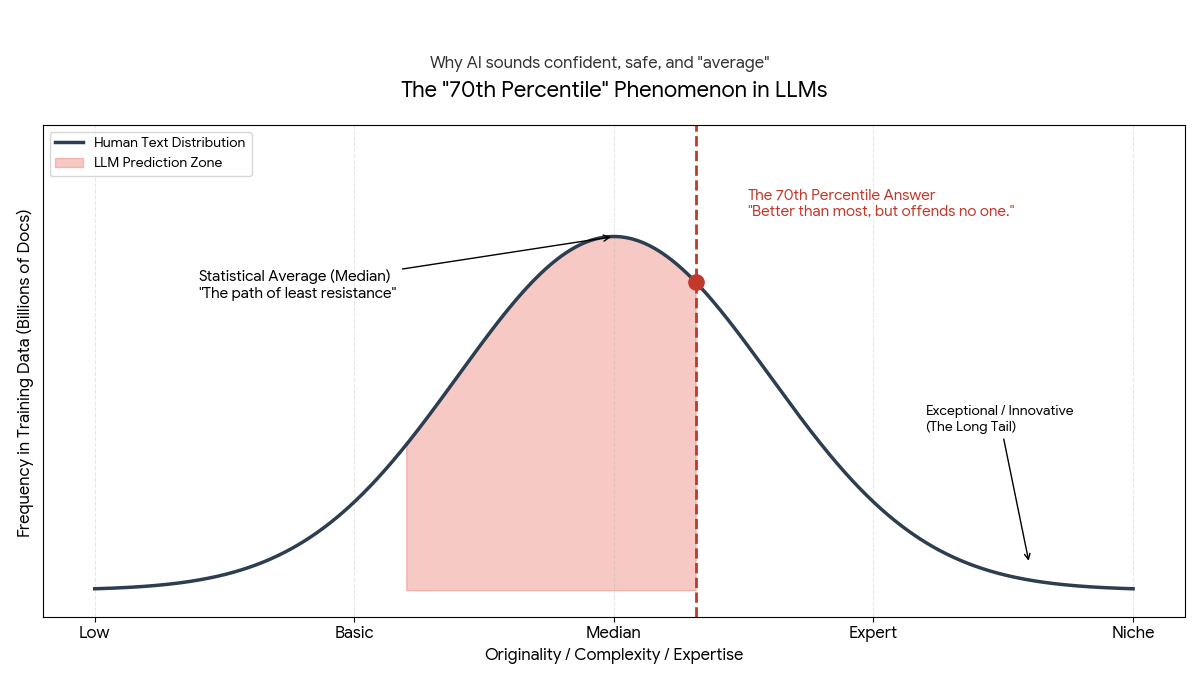
This is not a bug. It’s meant to be average. It will give the 70th percentile.
But you want the exceptional, the 95th percentile.
And it has a consequence that almost nobody talks about.
#2. The confidence trap.
Here’s something counterintuitive: the more confident AI sounds, the more suspicious you should be. Real expertise is messy.
When you ask a great strategist for advice, they don’t give you a clean answer. They say, “It depends.” They ask clarifying questions. They point out exceptions. They tell you about the time it didn’t work.
That mess is the expertise.
AI doesn’t do this. AI gives you the clean, confident, well-organized answer. Headers. Bullet points. Authoritative tone.
This is the trap (when prompted wrong).
When you’re not an expert, confidence feels like competence. You read the output and think: “This sounds like someone who knows what they’re talking about.”
But you’re pattern-matching on the wrong signals. You’re mistaking legibility for quality. When you ARE an expert, you see it immediately. The output feels like talking to someone who read a lot of books but never did the work. They use the right words. The structure looks professional. But something is off.
It’s too clean. Too confident. Too… agreeable.
AI has consensus.
And consensus is just another word for average.
You didn’t subscribe to this newsletter to be average.
#3. What expertise (actually) is.
When I say “use AI for things you’re an expert in,” I don’t mean “things you know about.” I mean something more specific.
Expertise isn’t knowledge. It’s a set of capabilities that takes years to develop, and that AI fundamentally cannot have (because of the 70th percentile).
Here are the signs you are an expert at something:
1. You feel wrongness before you can name it.
This is taste. And it’s weirder than people realize.
A designer looks at a layout and feels the spacing is off, before measuring anything. A writer reads a sentence and knows it’s clunky before identifying the passive voice. A strategist hears a recommendation and thinks “that’ll never work”, before articulating why.
It’s pattern recognition built from thousands of reps. You’ve seen so many examples of good and bad that your nervous system responds before your conscious mind catches up.
AI doesn’t have this. AI has seen more examples than you ever will, but it doesn’t feel anything about them. It has no visceral response to quality. It just predicts the next likely word (according to a massive corpus of average).
When you’re an expert, you read AI’s output and something in your gut says “no.” You might not be able to explain it yet. But you feel it.
That feeling is the asset.
2. You have scars.
Constraints aren’t rules you decided to follow randomly.
You learned them the hard way.
“Never present strategy without a ‘what kills this’ section.” — Because you got blindsided in a board meeting once. Never again.
“Never commit to a timeline without 40% buffer.” — Because you shipped late three times and lost a client.
“Never use jargon in the first paragraph.” — Because you watched readers’ eyes glaze over and learned that clarity beats cleverness.
“Never design without knowing how it fails.” — Because you built something beautiful that broke the first time someone used it wrong.
These constraints are invisible. No one would know them by looking at your work. But they’re everything. They’re the difference between someone who’s done the work and someone who’s read about the work.
AI has no scars. It’s never shipped late. Never lost a client. Never sat in silence after a pitch that bombed. It doesn’t know what you’d never do again.
Unless you tell it.
3. You know where the danger is.
Every domain has landmines. Places where amateurs blow up, and experts step carefully.
A consultant knows the real risk isn’t the strategy → it’s internal politics. The recommendation dies in a meeting you weren’t invited to.
A designer knows the real risk isn’t the design → it’s the edge case. The screen that breaks when someone enters a 47-character name.
A writer knows the real risk isn’t the writing → it’s the wrong frame. Solving a problem the reader doesn’t think they have.
An executive knows the real risk isn’t the plan → it’s the second-order effects. The team you demoralize. The precedent you set.
AI doesn’t see landmines. It sees the obvious path. It gives you the textbook answer → the one that works in the case study but explodes in the field.
You’ve stepped on the mines. You know where they are.
4. You know what your audience won’t say.
This is the deepest one.
When you truly know your audience, you know what they’re afraid of but won’t admit. You know the objection they’ll raise and the one they won’t. You know what they’ve tried before and why it failed.
A consultant who knows their client: “They’ve been burned by two agencies who overpromised. They’ll reject anything that sounds too confident. I need to lead with risks.”
A writer who knows their reader: “They’ve read a hundred posts on this topic. They’re skeptical of anyone who sounds like everyone else. I need to say something they haven’t heard.”
A designer who knows their user: “They’re going to try to break this. They’ll enter data wrong. They’ll click things in the wrong order. I need to design for the chaos.”
AI knows “marketers” or “executives” or “small business owners.” Generic categories.
You know your marketers, your executives.
The specific humans with specific fears.
That’s what expertise actually is. Not knowledge. Not information.
A felt sense of quality. Scars from past failures. A map of the landmines. And an intimate understanding of the humans you’re trying to reach.
AI has none of these. But you do.
And when you give AI your expertise as context, you’re not hoping it will “Act like an expert”. You’re asking it to draft while you—the expert— steer the project.
Here’s how:
#4. How to be the expert (and use AI).
Before you prompt, extract your expertise into a document.
A file that contains the things AI can’t know: your taste, your scars, your landmines, your audience. Understand why (and copy the how right after).
Step 1: Upload what you love.
Find 5 examples of work you think is excellent. Yours or someone else’s. PDFs, screenshots, links, copy-pasted text. Upload them to Claude or ChatGPT.
Step 2: Extract the patterns.
Prompt Claude (or any AI) this:
These are examples of [writing/design/strategy/etc.] I think are excellent. I'm building a markdown context file I'll upload to future Claude conversations so you can match my standards. Analyze what makes each example work. Extract specific patterns I can reuse. Format each one as a rule starting with 'Always' or 'Never'.Step 3: Add your scars.
Now, continue the conversation on the same chat:
Now I’ll tell you my personal constraints. These are rules I learned the hard way. Ask me questions one by one to extract them: what I never do, what I always do, where I’ve been burned before, what mistakes I see others make.Answer each question. Let it pull the knowledge out of you.
Pro tip: Use Claude Cowork with Opus 4.5. It’s the best at this.
Step 4: Add your audience.
Continue with this:
Now ask me about my specific audience. Who they are, what they’ve tried before, what they’re afraid of, what they won’t say out loud, what makes them trust or distrust.Step 5: Export.
The final prompt:
Compile everything into a single context file I can reuse. Use this format:

STANDARDS: [what good looks like]
CONSTRAINTS: [my rules]
LANDMINES: [where things go wrong]
AUDIENCE: [who I’m writing for]
Copy the output. Paste it in a Google Doc. Download as markdown.
This takes 2-3 hours. Once. '
Then you use it for months exactly like this:
You upload your Style markdown file to a chat (Claude Cowork).
You prompt it (very simply) like this:
I uploaded my context file. It contains my standards, constraints, landmines, and audience. Read it fully before starting. Then, I want you to do this task: [YOUR TASK]. Before you write anything, list the 3 rules from my file that matter most for this task. Then give me your execution plan.

[Claude responds with the 3 rules]

Then you prompt it again:

Good. Now do [your task]. Follow my context file strictly. If you're about to break one of my rules, stop and tell me.
You steer the wheel with follow-up prompts.
Most people forget step 3. Here’s how to steer the wheel (like an expert):
#5. The steering wheel.
AI’s first draft will be 60% there.
That’s fine. That’s the point.
When you’re an expert, 60% is useful. You can see exactly what’s wrong. You know.
Here’s how iteration actually works:
You redirect.
Each follow-up takes 30 seconds:
"Paragraph 2 is too generic. Make it specific to B2B SaaS."

"You missed the risks. Add a section on what could go wrong."

"This sounds like a textbook. Make it sound like someone who's actually done this."

"Wrong angle. They don't care about features. They care about not looking stupid in front of their board."
The non-obvious ones:
"What did you leave out?"

"Argue against this."

"Write this for someone who's seen this advice 100 times."

"What's the uncomfortable truth you're avoiding?"

"What context would change this completely?"

"Now give me the 20% that will yield 80% of the results."
The formula:
AI writes v1 (using your context file)
You read it and name what’s wrong (this is where your expertise lives)
AI rewrites based on your direction (from 60% → to 95%)
You write the final 5%. The parts only you can write.
The magic is in steps 2 and 4.
Step 2 is your taste. Step 4 is your voice.
AI does the prep. You do the surgery.
#6. The shift.
Most people use AI like this:
I don’t know X, so AI will figure it out for me.Flip it.
I know X deeply, so AI will help me move faster while I steer.Stop using AI for the things you’re bad at. You can’t tell if it’s wrong.
Start using AI for the things you’re great at. You’ll catch every mistake.
You’ll push it further than it would go alone. You’ll add the spice & pepper that makes it yours. Only an expert could push a team to do exceptional work.
AI is just a mirror.
It reflects what you bring. So bring your best.
Too long, didn’t read.
Skip the guide, and do this:
Build your context file. Standards, scars, landmines, audience. 2-3 hours once.
Upload it before every task.
Steer with follow-ups. Write the final 5%.
It instantly puts you in the top 1% of AI users.
Now, how can you quickly go from top 1% to top 0.1%?
✦ Join a community of obsessed AI users (like my Slack with 900 professionals).
✦ Play with AI. You learned through games as a kid. You are still a kid.
✦ Use AI for your strengths, not your gaps. Let the mirror reflect your best.
AI is a mirror. Bring something worth reflecting.
Humanly yours - Ruben.
PS: I consult Fortune 500 companies in the US to deploy this exact system: context files, steering, the 95/5 split. 2 spots left for Q2. DM me on LinkedIn.
I read every one of my messages there.
We need these in t-shirts: “Expertise isn’t knowledge.” And so read this part in Liam Neeson’s voice: “It’s a set of capabilities that takes years to develop, “. Great job outlining the how transfer one’s knowledge onto LLM. Next move, create it as digital worker version of yourself, put it to work on your behalf so you can enjoy life, which AI can’t do for you! And acquire more experience while doing so! Agentpreneurship.
This is the part most people skip. They want the template and the shortcut.
But the shortcut doesn't work if you can't spot when AI is wrong.
That's the whole point.