
Workaholic.
You have an unhealthy obsession with AI.

AI didn’t make you work less.
It made you work (much) more. And it’s not necessarily good.
I met dozens of people this year who told me the same thing. They work past midnight. They ship more than ever. They’ve never felt more productive.
But they’ve never been more stressed. More lost. More exhausted than when they started. And these aren’t lazy people. They adopted AI early, they prompt well, and they do the work of three people on their own.
But is doing more doing better?
Most people using AI are sprinting. Fast. But they sprint in the wrong direction.
At the end of this newsletter, you will be certain how to move in the right direction.
AI doesn’t feel like work.
Every tool before AI felt like work.
Excel felt like work. Email definitely felt like work. Even Google search felt like a task you wanted to finish and move on from. You had to manually scroll, exit the ads, copy and paste the parts that mattered, and avoid fake sponsored articles.
But prompting AI? It feels like chatting with a friend. You type a sentence, something comes back, you tweak it, you send another one. It’s almost fun.
And that’s the trap.
People send a prompt before bed “just to see what comes back.” They prompt during lunch, during meetings, while waiting for a file to load.
It doesn’t register as work in their brain. But they are. All the time.
AI removes the friction of starting. That’s great. But it also removes the friction of stopping. And if stopping feels harder than continuing, you have an addiction.
And Harvard just confirmed it a couple of weeks ago:
Harvard just confirmed it.
Harvard ran an 8-month study at a 200-person tech company. Nobody forced anyone to use AI. They all chose to. And they all ended up working more.
Three things happened, across the board:
People started doing other people’s jobs because AI made it feel easy. Product managers wrote code. Researchers did engineering tasks. Everyone absorbed work that used to require extra hires.
Work spilled into every break. Every evening. Every “quick 5 minutes.” The conversational style of prompting made it feel casual, so it crept into lunch, into commutes, into the time your brain is supposed to recover.
Everyone multitasks more. Multiple AI threads running at once. Constantly checking outputs. A permanent state of juggling.
And here’s the finding that should make you stop and think: every single person in the study felt more productive. Most felt busier than before.
One engineer said it best (I’m paraphrasing):
“You thought you’d work less because AI makes you faster.
But you don’t work less. You work the same. Or more.”
So why am I writing a newsletter on us being AI-holic?
Because there is a hidden enemy. I call it performative productivity.
(Stick until the end, I will share my remedy)
The real enemy: performative productivity.
It’s 11 pm. You shipped all day. New landing page. Rewrote the sales deck. Drafted a content calendar. Fixed that email sequence. You were ON.
And now you’re sitting there, tired, scrolling your own output, and you can’t name one thing that actually moved you forward. Not one.
That’s the feeling. That’s what I keep hearing from people. Not “I’m lazy.” Not “AI doesn’t work.” It’s “I did so much today, and I have nothing to show for it.”
AI lets you skip the hardest part of work: deciding what’s worth doing in the first place. Before AI, starting something was hard. So you were forced to think about whether it was worth starting. Now? You type a sentence, and something exists. There’s no friction to make you pause and ask: wait, does this actually matter?
So you don’t ask. You just keep going. You ship the deck, the doc, the draft, the redesign. You feel the momentum. And at the end of the week, you realize the momentum was circular. You moved fast. You went nowhere.
Look, I’m all the more for “fast shipping + ‘show don’t tell’ using AI”. It’s magic. But you must fight directionless to make sure you do something worth pursuing.
Here are my 5 rules:
5 rules to fight performative productivity.
Here’s my gameplan at my company:
1. Before you prompt, write one sentence about what you’re solving.
If you can’t explain the problem in one sentence, AI will generate noise. And you’ll spend your night editing that noise. One sentence. The problem. Write it down. Then prompt.
For example, “Grow my newsletter 10% faster”.
2. Kill 3 tasks for every 1 task AI helps you add.
AI makes adding work easy. Nobody teaches you to subtract. For every new thing AI helps you ship, ask: what 3 things can I stop doing?
This is taste in action.
Saying no to more things so you can say yes to the right ones.
For example, “[help me here]”.
3. Set a “last prompt” time.
Just like you (should) have a time you stop checking email, set a hard stop for AI. After 8 pm? No prompts.
I know this sounds basic. But I’ve talked to people who prompt at midnight, at 2 am, “just one more.” Break the pattern. Understand that the most productive behavior you can have is to rest.
The work will be there tomorrow. Your brain won’t be if you don’t let it rest.
4. Ask yourself: am I doing more things or the right things?
Are you closer to your actual goal? Or did you just ship a lot of stuff that felt good in the moment? If you can’t answer that honestly, you’re busy. Not productive.
I made a matrix here to help me stay on the right track.
But feel free to create your own matrix with this template:
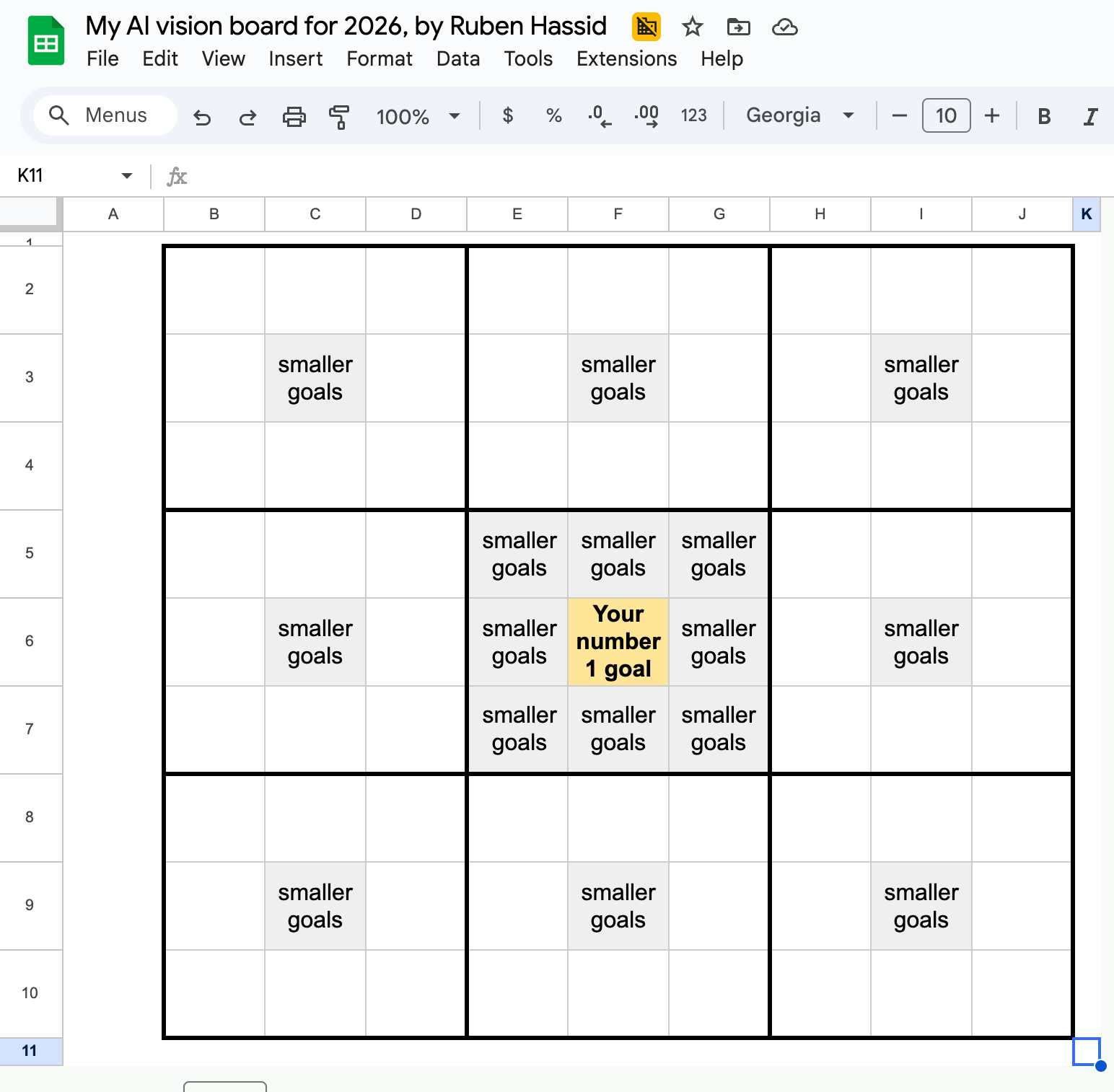
5. AI writes v1. But YOU decide if v1 should exist at all.
This is the most important rule.
Just because AI can draft something in 30 seconds doesn’t mean it should be drafted. That’s why anyone can make a Linkedin post in 30 seconds, but very few can grow an account to 10,000 followers in 17 days (we did).
Before you ask AI to write it, design it, or build it, ask yourself: does this need to exist? If the answer is “I don’t know, but it’s easy, so why not,” you have a problem.
Don’t sprint before knowing where you're going. Have the right direction first.
But how to start (exactly)?
Open Claude (or whatever you use).
Run these two prompts. In that order. Don’t skip the first.
Prompt 1: Find your real goal.
Audit your productivity against multiple goals at once.
And pick the one goal you (really) want.
I’m going to list everything I’m working on right now. Ask me tough questions to help me figure out which ONE of these actually matters most to my growth in the next 90 days. Challenge me. Don’t let me pick 3. Force me to pick 1.

Here’s my list: [paste your current projects/tasks]
Prompt 2: Audit your week.
Here’s my one goal: [paste it].
Now here’s everything I did this week: [paste your tasks/output]. Score each task: does it directly move me toward that goal, or was it performative productivity? Be brutal. Then give me a plan for next week that only includes what actually matters.
Read the answer. You’ll want to argue with it. That’s how you know it’s working.
Most people use AI to produce more. Start using it to see clearly. That’s the difference between an AI-holic and someone who actually knows what they’re doing.
Now, how can you go from planning to mastering?
Do this:
✦ Join a community of obsessed AI users (like my Slack with 1,039 professionals).
✦ Pick one tool (most likely Claude for most of you) and master it.
✦ Use AI for your strengths, not your gaps.
Humanly yours - Ruben.
PS: I consult Fortune 500 companies in the US for AI assessment and workshops. 1 spot left for Q2. DM me on LinkedIn (only). I read every one of my messages there.
The line here that resonsted was that AI removes the friction of starting and the friction of stopping. That’s huge.
We’ve optimised activation energy and deleted termination energy. The constraint is no longer skill, it’s judgement. The risk isn’t laziness, but directionlessness at speed.
Where I see that most is in decision quality. When everything is draftable in 30 seconds, the scarce skill becomes deciding what deserves to exist at all. That’s strategic muscle, not just prompting skill.
Perhaps the deeper issue isn’t performative productivity, but outsourced thinking? If AI enters before we’ve clarified our own position, it amplifies noise and "slop" rather than signal or insight.
Perhaps the principle needs to be "Think first, prompt second".
Then likewise, "AI as amplifier, not as substitute".
The friction AI removed wasn't just the friction of starting work. It removed the friction that forced you to feel whether the work mattered. Before AI, starting something hard gave your gut time to ask 'is this worth doing?' Now that pause is gone. The solution isn't a matrix or a prompt. It's learning to hear the signal AI made it easy to ignore.