
Generic.
How to get out from the ChatGPT generic jail.
No one told you why ChatGPT’s output sometimes feels... meh.
So I will.
You know that moment you ask ChatGPT to do something.
And it explains it perfectly.
But when it comes to executing… it’s all sloppy obviousness.
New research tells us why. And I will give you the proper instructions to avoid it.
This is not about prompting harder.
This is all about understanding your AI has a split brain.
At the end of this newsletter, you will master:
Why ChatGPT explains brilliantly but writes generic.
How to flip AI from creator to critic (and get 10x better results).
My copy and paste prompts to get the most from the split brain.
1. ChatGPT has a split brain.
Researchers just discovered something wild.
It’s called “Computational Split-Brain Syndrome.”
Here’s the paper: Comprehension Without Competence: Architectural Limits of LLMs (arXiv 2507.10624, November 2025).
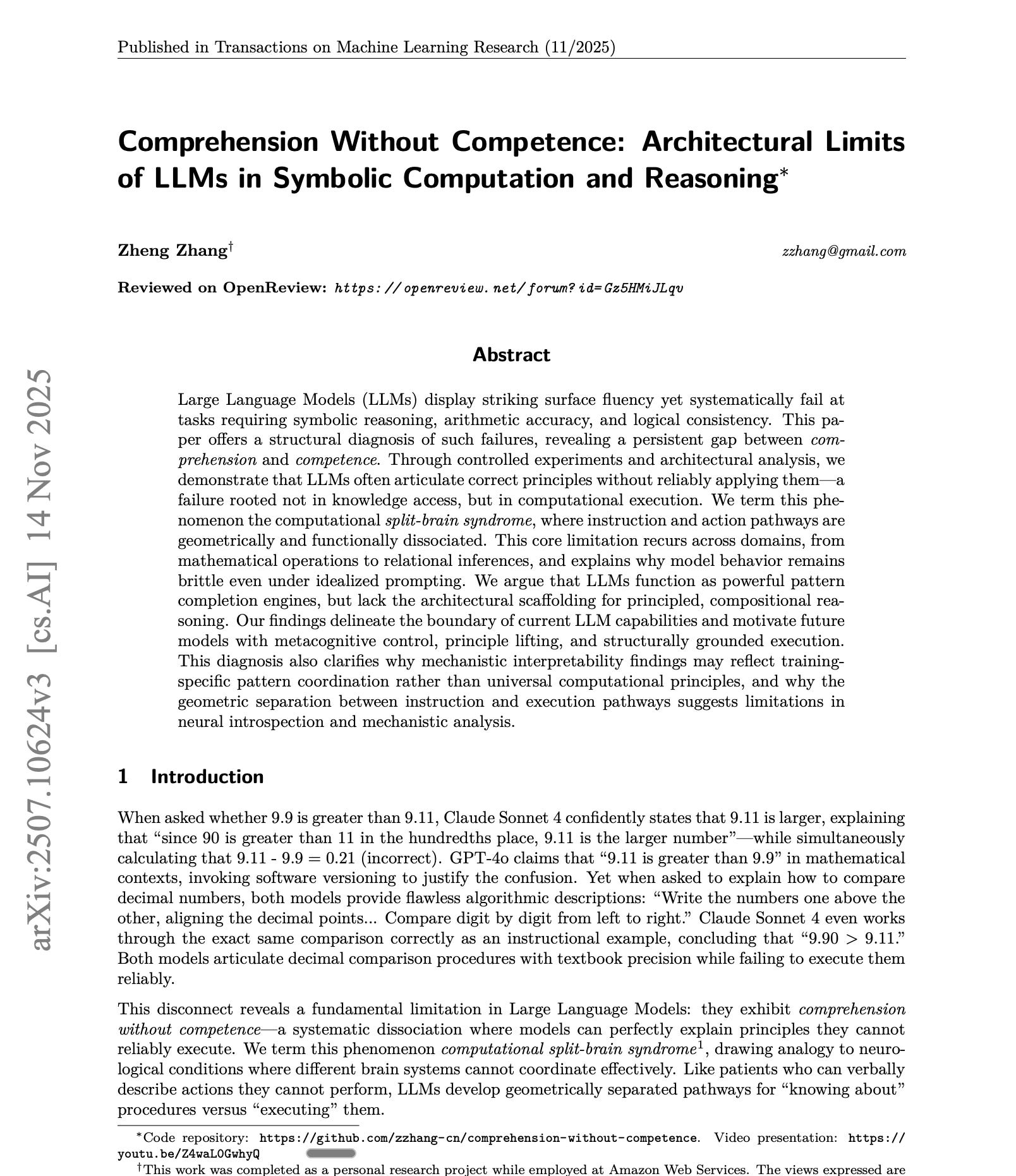
The finding? AI can perfectly explain how to do something—and completely fail to actually do it.
Understanding ≠ Ability.
Think about it.
✦ ChatGPT can explain what makes a great headline. It writes generic ones.
✦ ChatGPT can critique your writing brilliantly. Its rewrites are bland.
It knows the rules. It can’t apply them.
You are new? Access my archive of guides: https://docs.google.com/document/d/1pWuMCBVQo1zKcgKltX_BZxAr31KgxmOlp3Vzvmc5Hxc/edit?usp=sharing.
Why this happens.
The researchers found that LLMs have two separate “pathways”:
1) The instruction pathway — understanding, explaining, teaching.
2) The action pathway — actually doing, executing, creating.
These pathways are geometrically separated in the model’s architecture.
It’s not a training (how ChatGPT learned) or a prompting problem (how you use it). It’s baked into how transformers (= LLMs = ChatGPT) work.
“LLMs articulate correct principles without reliably applying them—failure rooted in computational execution, not knowledge access.”
This explains every frustration you’ve had with AI writing.
How this shows up for writers.
You ask: “What makes a great hook?”
ChatGPT nails it: specificity, curiosity gap, emotional triggers, power words. Textbook-perfect.
You ask: “Write me 10 hooks for my product.”
ChatGPT produces... fine. Generic. Forgettable.
It understood what you wanted. It couldn’t execute what you wanted.
You ask: “What’s wrong with this landing page?”
ChatGPT delivers: “The headline lacks specificity. The CTA is buried. The value prop is unclear.”
Sharp. Useful. Brilliant.
You ask: “Fix it.”
The rewrite is somehow worse. Blander. It diagnosed the surgery but couldn’t perform it.
You ask: “How should I position against competitors?”
ChatGPT gives you Porter’s Five Forces, differentiation strategy, blue ocean thinking.
A perfect MBA answer.
You ask: “Write the positioning statement.”
It produces the same vanilla copy everyone uses.
You must change your tactic.
2. The tactical flip.
Here’s what this means for you:
Stop using AI as a creator. Start using it as a critic.
❌ Don’t ask AI to...

- Write your sales page
- Create your positioning
- Generate your hooks
- Write your emails
- Be creative for you


✅ Ask AI to...

- Critique your sales page draft
- Poke holes in your positioning
- Explain why your hook does/doesn’t work
- Tell you what’s weak in your emails
- Explain what makes something creative
3. Copy-paste prompts.
Prompt #1: The Critic: