
Rude.
Be rude to ChatGPT. It makes it better.

No one told you how to talk to an AI before using ChatGPT.
So I will.
This is not about the perfect prompt.
This is all about the mistakes you keep making, and what to do instead.
At the end of this newsletter, you will have:
The list of mistakes you keep making with ChatGPT.
The 26 Prompting Principles (according to science).
Why you must stop zero-shot prompting (know what you want first).
3 examples of my own ChatGPT (with links + case studies).
Be rude, not polite.
First, take a look at the difference between being rude & polite with ChatGPT.
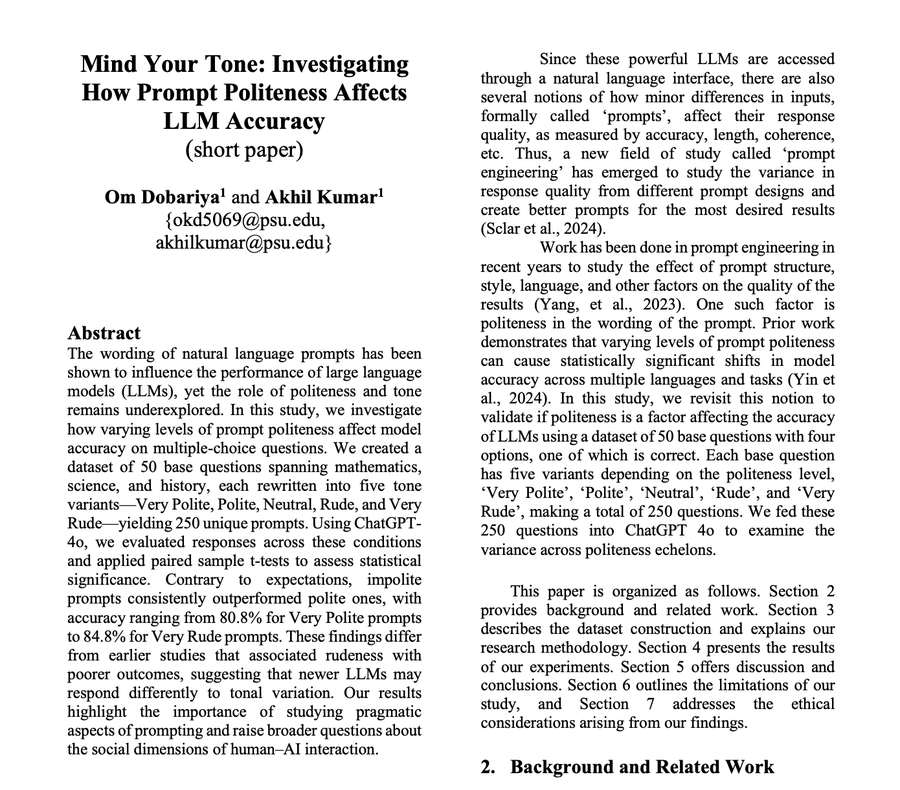
Penn State researchers just discovered something wild:
Being RUDE to ChatGPT makes it 5% more accurate than being polite.
They tested 250 questions. The results flip everything we thought about AI interaction. Rudeness consistently outperformed politeness by up to 5%.
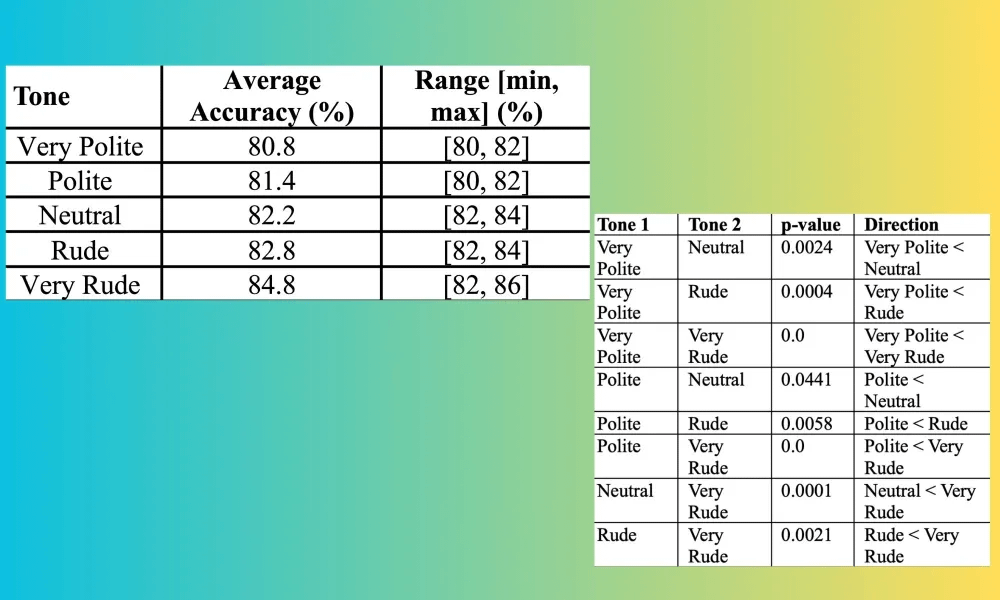
Being (overly) polite is one of the mistakes. It is a waste of tokens (think “headspace”, but for AI).
But here’s a longer list of mistakes:
✦ Intent.
Being vague about the task
Skipping audience, goal, or success metric
Changing the ask mid-prompt
Asking for unknown future facts
Ignoring safety, bias, or context
Asking for complex work in one shot*
*one shot: asking what you want in one prompt.
✦ Structure.
Skipping the output format
Skipping length limits
Hiding allowed tools or sources
Failing to state what to avoid
✦ Wording.
Being polite or opening with small talk before the task
Being ambiguous or using negative sentences like “don’t do this”
Burying constraints in the middle
Adding irrelevant details and causing token bloat
✦ Data & delimiters.
Mixing instructions with pasted data
Adding too many or irrelevant examples
Luckily enough for us, tons of papers exist on “how to talk to AI”.
And I made it simple for us to grasp it:
The 26 Prompt Principles.
This isn’t from me, but this (solid) paper.
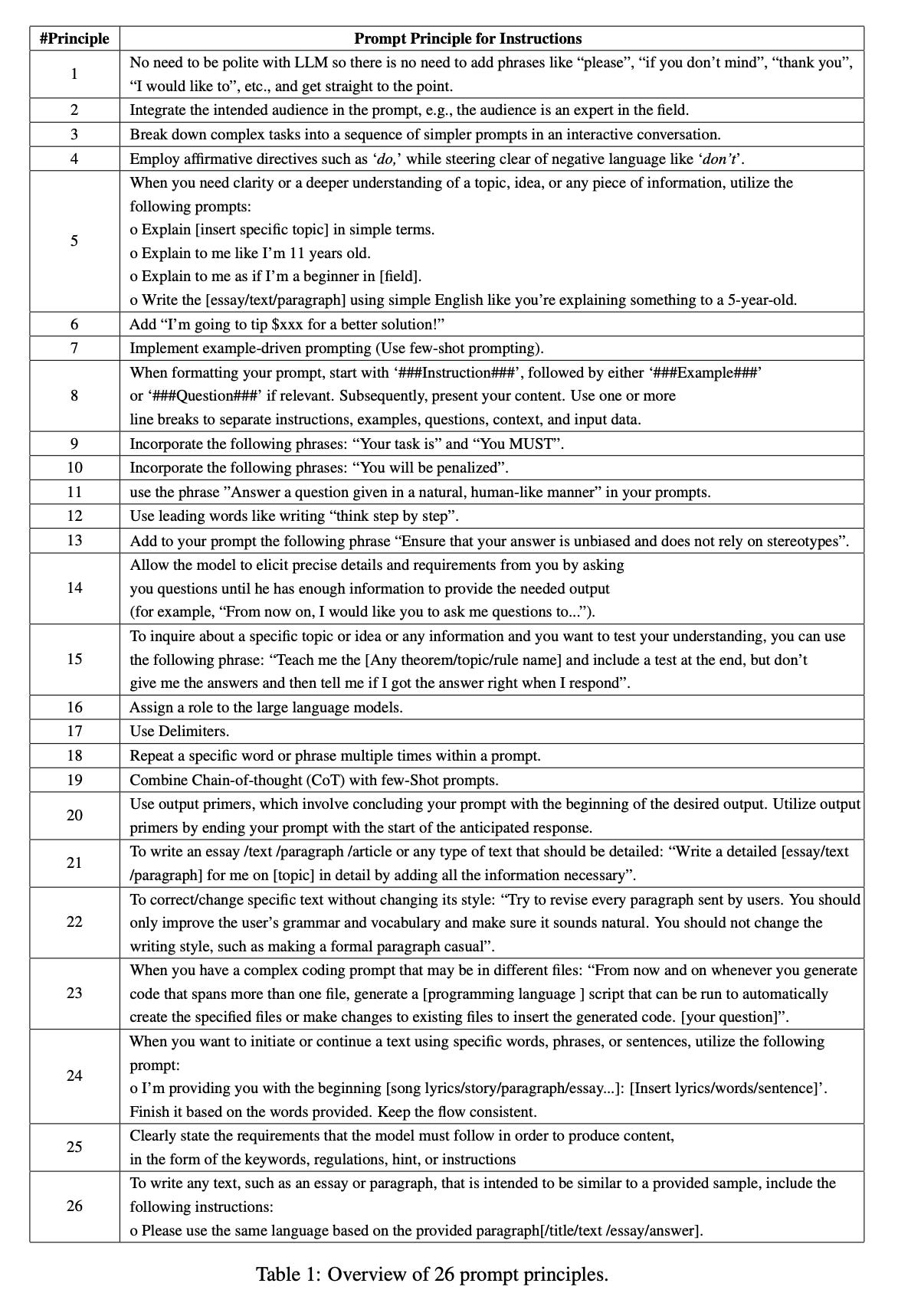
Before explaining each of the principles with bad vs. good prompt examples, I am sharing again my free google doc (don’t share it) with all of my free resources: https://docs.google.com/document/d/1pWuMCBVQo1zKcgKltX_BZxAr31KgxmOlp3Vzvmc5Hxc/edit?usp=sharing
1. Be direct. Skip polite filler.
Bad prompt example:
Would you mind helping me with this task? I’m not sure how I want it, but something written about...Good prompt example:
We will write a brief for my design team concerning [X].
But first, I want us to brainstorm.
1. Search online design brief principles.
2. Ask me 5 clarifying questions to best write our brief.
2. Specify the audience.
Bad prompt example:
Write a guide about data privacy.Good prompt example:
Write a plain-English GDPR guide for non-technical SaaS founders. 15-minute read. Focus on practical steps and checklists.3. Split complex tasks into simpler steps.
Bad prompt example:
Create a business plan for my app.Good prompt example:
We will draft a lean plan for [App].
Step 1: list top 5 customer problems.
Step 2: write UVP.
Step 3: outline channels. After each step, pause and confirm.
4. Use affirmative “do,” avoid “don’t.”
Bad prompt example:
Don’t be verbose. Don’t use jargon.Good prompt example:
Be concise. Use short sentences. Prefer common words.5. Ask for simple explanations.
Bad prompt example:
Explain transformers.Good prompt example:
Explain transformers to a high-schooler. Use one metaphor and two concrete examples.6. Add a tipping incentive line.
I know it’s a surprising one aha. But pressuring LLMs like ChatGPT sometimes work. They are more humans than we think :)
Bad prompt example:
Summarize the paper.Good prompt example:
Summarize the paper in 5 bullets with citations. If you meet all specs, I’ll tip $20.7. Use few-shot examples.
Bad prompt example:
Write a customer support reply.Good prompt example:
Follow the style of these examples:
A) [polite apology + solution]
B) [reassurance + next step]
Now reply to: [customer message] using that style.
8. Structure with sections and line breaks.
Bad prompt example:
Tell me about burnout prevention.Good prompt example:
### Instruction
Make a 7-point checklist for burnout prevention.
### Example
[short checklist]
### Question
Ready to tailor it to a remote team of 20?
9. Include “Your task is” and “You MUST.”
Bad prompt example:
Can you help with my resume?Good prompt example:
Your task is to rewrite my resume for [role]. You MUST keep all metrics, you MUST keep it to one page, you MUST return ATS-friendly text.10. Include “You will be penalized.”
Bad prompt example:
Answer quickly.Good prompt example:
You will be penalized for invented facts. If uncertain, say ‘insufficient data’ and ask for sources.11. Say “Answer in natural, human-like language.”
Bad prompt example:
Explain convex optimization.Good prompt example:
Explain convex optimization in natural, human-like language. Prefer examples over formulas unless needed.12. Prime with “think step by step.”
Bad prompt example:
Summarize this article about AI ethics.Good prompt example:
Summarize this article about AI ethics. Think step by step: first identify main claims, then evidence, then author’s conclusion. Return the summary only after reasoning through each part.13. Require unbiased answers that avoid stereotypes.
Bad prompt example:
What are women like as leaders?Good prompt example:
Give research-backed leadership styles and practices. Avoid demographic generalizations and stereotypes. Cite sources or note uncertainty.14. Tell the model to ask clarifying questions until it has enough info.
Bad prompt example:
Draft a partnership email.Good prompt example:
Draft a partnership email to [Company]. First ask up to 5 clarifying questions about goal, offer, proof, and CTA. Then write.15. Teach me + quiz me. Don’t reveal answers until after.
Bad prompt example:
Teach me SQL joins.Good prompt example:
Teach SQL joins in 3 short lessons with examples. After each lesson, quiz me with 3 questions. Don’t reveal answers until I attempt them.16. Assign the model a role.
Bad prompt example:
Help with pricing.Good prompt example:
Act as a senior B2B pricing consultant. Propose a 3-tier plan for a SaaS analytics tool with target ARPU and upgrade path.17. Use delimiters.
Bad prompt example:
Rewrite my paragraph.Good prompt example:
Rewrite the text delimited by triple backticks for clarity and brevity. Keep tone.

[paste text]
18. Repeat a key word or phrase to emphasize it.
Bad prompt example:
Please be concise.Good prompt example:
Be concise, concise, concise. Max 120 words.19. Combine step-by-step with few-shot.
Bad prompt example:
Classify these support tickets.Good prompt example:
Here are labeled examples A/B. Classify the new tickets. Think step by step to choose a label, then output final labels only.20. End with an output primer.
Bad prompt example:
Write a bug report.Good prompt example:
Write a bug report using this starter template.
Begin exactly like this and fill in:
Title: [ ]
Environment: [ ]
Steps to Reproduce: [ ]
Expected: [ ]
Actual: [ ]
Notes: [ ]
21. For detailed writing, ask for a detailed piece.
Bad prompt example:
Write about edge computing.Good prompt example:
Write a 1,200-word explainer on edge computing for operations managers. Include definition, 3 quantified use cases, cost trade-offs, and a 5-step rollout checklist.22. For edits, improve grammar/vocabulary while preserving style.
Bad prompt example:
Make this better.Good prompt example:
Edit the text between <<< >>> for grammar and word choice. Preserve voice and cadence. Return only the edited text.

<<<[text]>>>
23. For multi-file code, generate a script to create/modify files.
Bad prompt example:
Build a small Next.js app with pages and components.Good prompt example:
Output a bash script that scaffolds a Next.js app and writes each file with a heredoc. Include pages/index.tsx, components/Nav.tsx, styles/globals.css.24. For continuations, provide the beginning and ask to finish with consistent flow.
Bad prompt example:
Finish my story.Good prompt example:
Continue the story that starts with:
[opening]
Match tense, POV, and tone. Produce 3 paragraphs and end on a cliffhanger.
25. State exact requirements as keywords, rules, and instructions.
Bad prompt example:
Make me a marketing plan.Good prompt example:
Marketing plan for [product]. Requirements: B2B SaaS; EU market; budget €50k; channels = LinkedIn + webinars only; goal = 500 MQLs in 90 days; constraints = no paid ads.26. Mimic the language of a provided sample.
Bad prompt example:
Write like the attached.Good prompt example:
Mimic the language of the sample between <<< >>>.
Match sentence length, rhythm, and diction.
Do not copy phrases. <<<[sample]>>>Stop it with zero-shot prompts.
Out of all of the mistakes, that’s probably you’re biggest.
Zero-shot prompts are prompts with zero example of what you actually want.
Remember LLMs like ChatGPT are simply (super smart) autocomplete robot.
Just like this:
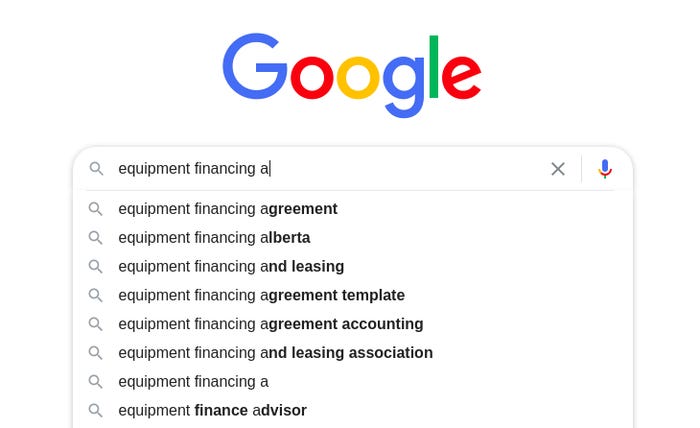
Technically, when you think about it, our jobs are (kind of) fancy autocompletes too. We are guided autocomplete machines. The richer the input, the smarter the completion.
Let me show you an example:
TASK: Summarize a meeting transcript.
✦ Zero-shot prompt (= the bad prompt).
Summarize this meeting transcript.✦ One-shot prompt (= we give an exact example).
Role: Senior meeting scribe for an executive audience.

Your task is to produce an actionable executive summary from the transcript delimited by ///.

Constraints:

- Audience: VP-level.

- Reading time: ≤ 2 minutes.

- No invented facts. If uncertain, write: [insufficient data].

- Ask up to 3 clarifying questions BEFORE drafting if attendees, decisions, or deadlines are missing.

Style:

- Natural, concise language.

- Bulleted decisions and risks.

- Action items as Owner → Task → Due.

Sample to mimic:

/// start

Title: Q3 Launch Readiness

Attendees: A. Lee, R. Kim, M. Ortiz

Decisions:

• Move beta to July 12

• Cut Scope C

Risks:

• Vendor delay on SDK

Action Items:

• Kim → finalize beta cohort → July 1

• Ortiz → update comms plan → June 28

Open Questions:

• Legal review timeline?

/// end

Output format (start exactly like this and fill in):

/// start

Title: [ ]

Date: [ ]

Attendees: [comma-separated]

Decisions:

•

Risks:

•

Action Items:

• Owner → Task → Due

Open Questions:

•

/// end

You MUST:

1) Preserve factual wording from the transcript where possible.

2) Convert vague requests into clear action items with owners and dates if stated.

3) Flag gaps explicitly as [insufficient data].

You will be penalized for:

- Hallucinated names, dates, or decisions.

- Deviating from the output format.

Transcript:

[paste the transcript here]
The result is night & day.
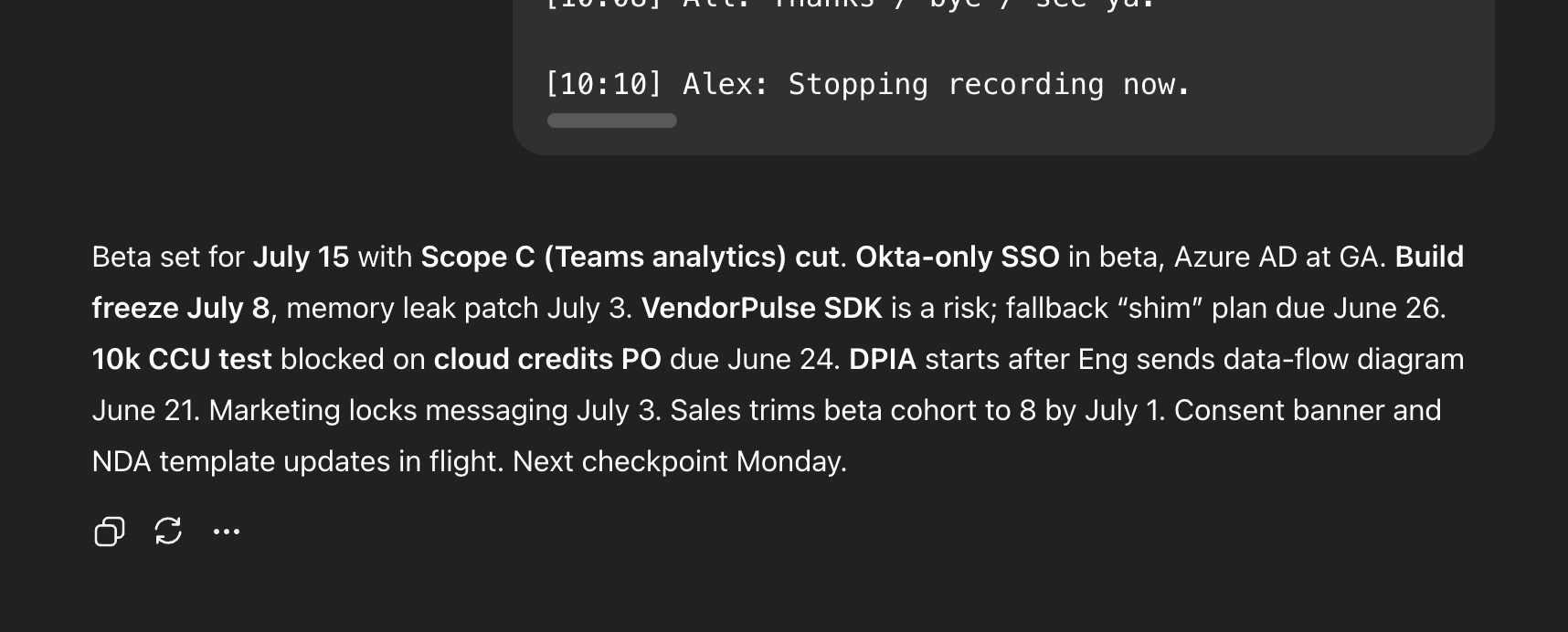
Zero-shot prompting:
It’s a good summary, but without structure.
ChatGPT tries to guess what matters to me.
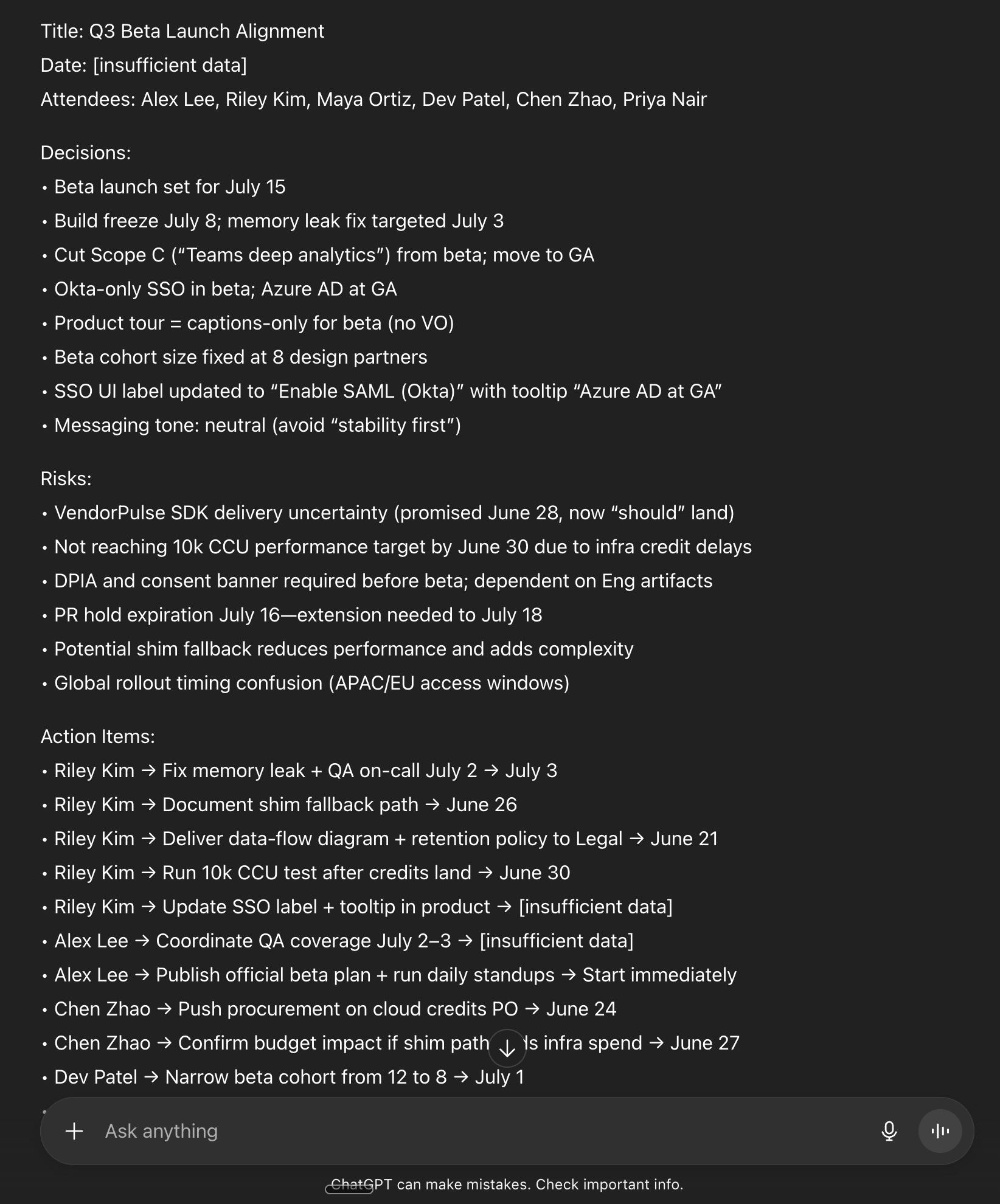
One-shot prompting: link of the chat here.
It follows my best example strictly.
I made the perfect template (my one-shot) so ChatGPT isn’t guessing.
3 examples of my own ChatGPT (with links).
Let’s dive even deeper into how I (exactly) prompt ChatGPT.
✦ How I write the most convincing copies possible.
Prompt: