
ChatGPT is obsessed with certain words: delve, tapestry, realm…
And also overusing expressions like: “It’s not [obvious thing] — it’s [other thing].”
You and I both need to stop writing like an AI.
They ruined it for us.
Delve. Tapestry. Analogies. Em dashes.
No one taught you how not to sound like an AI.
So I will.
At the end of this newsletter, you will master:
How to avoid the entire AI most-used words library.
How to recognize and delete the most-used AI expressions.
The copy & paste prompt to edit any text and remove its AI feel.
1. Never use these (AI) words.
Last week, you learned how to remove em dashes and make ChatGPT write like you. I think you should read this first, before jumping into this section.

So what’s up with the word “Delve”?
It’s the epitome of ChatGPT writing.
(I really wanted to use this word epitome. I am French. We use fancy words.)
Since the AI boom, “delve” has been everywhere.
Even in (serious) academic papers.

People pick up on it. And they hate it.
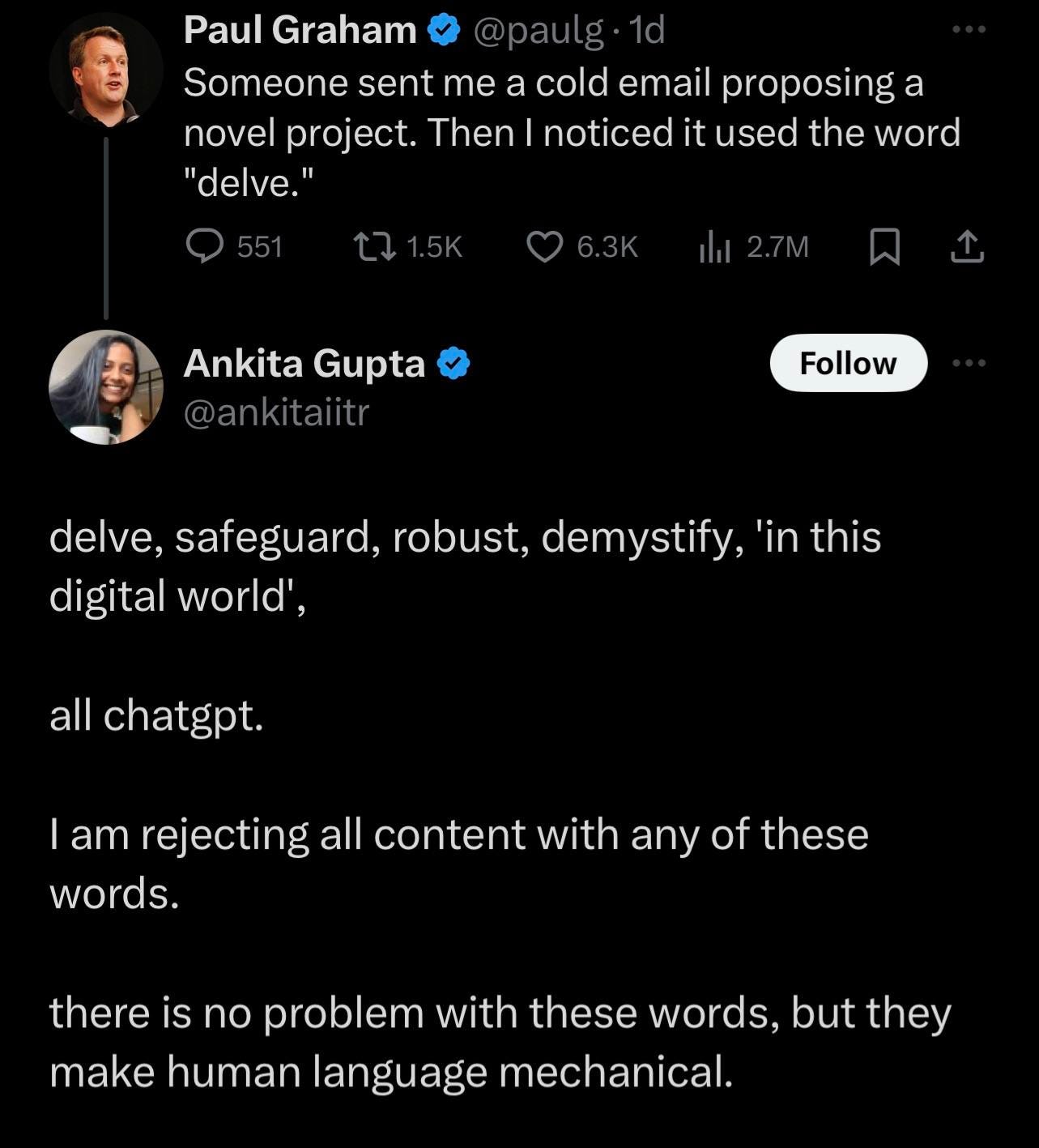
So I spent a dozen hours finding the entire “overused-AI-words-that-only-AI-overuses, not-other-normal-human-beings” library.
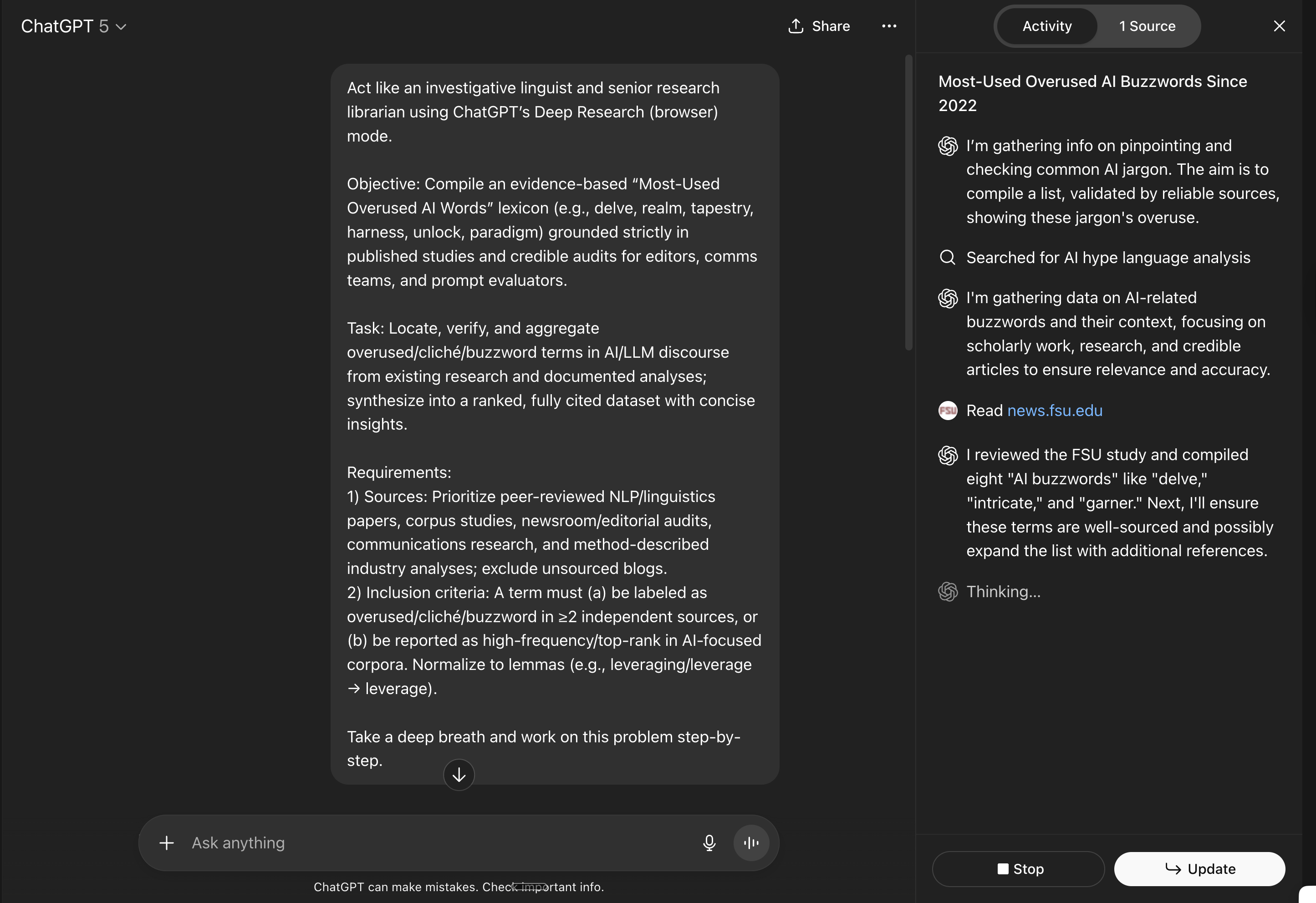
I made deep research on ChatGPT, Gemini, Claude, and Perplexity.
But also deep research on arXiv using Consensus.
Worth noticing, ChatGPT was the best at it.
If you’re interested in the method, this is one of my (many) prompts on ChatGPT Deep Research (you must use Deep Research for this):
Here is the list of banned words, overused by AI:
delve
realm
harness
unlock
tapestry
paradigm
cutting-edge
revolutionize
landscape
potential
findings
intricate
showcasing
crucial
pivotal
surpass
meticulously
vibrant
unparalleled
underscore
leverage
synergy
innovative
game-changer
testament
commendable
meticulous
highlight
emphasize
boast
groundbreaking
align
foster
showcase
enhance
holistic
garner
accentuate
pioneering
trailblazing
unleash
versatile
transformative
redefine
seamless
optimize
scalable
robust
breakthrough
empower
streamline
intelligent
smart
next-gen
frictionless
elevate
adaptive
effortless
data-driven
insightful
proactive
mission-critical
visionary
disruptive
reimagine
agile
customizable
personalized
unprecedented
intuitive
leading-edge
synergize
democratize
automate
accelerate
state-of-the-art
dynamic
reliable
efficient
cutting-edge
cloud-native
immersive
predictive
scalable
transparent
proprietary
integrated
scalable
plug-and-play
turnkey
future-proof
open-ended
intelligent
AI-powered
next-generation
always-on
hyper-personalized
results-driven
machine-first
paradigm-shifting
At the end of this newsletter, I will share how the prompt to ban them, forever.
So we tackled words. But the worst are definitely expressions.
More on section 2.
You are new? Access my archive of guides:
https://docs.google.com/document/d/1pWuMCBVQo1zKcgKltX_BZxAr31KgxmOlp3Vzvmc5Hxc/edit?usp=sharing.
2. Recognize and delete (AI) expressions.
Everyone is chasing perfect writing — few are getting there.
AI isn’t replacing writing — it’s replacing the need for writers.
…
………
……………………
I was kidding :)
I don’t write like this.
I just want to show you examples of disgusting AI expressions. I hate them.
“It’s not about XXX, but about redefining XXX.”
The worst part is that I sometimes use them myself—because they are still English expressions, just like I love em dashes. But again, they ruined it for us.
Anyway.
Let’s categorize every (stupid) AI expressions together.
The “IN A WORLD WHERE” DRAMA
Set up a vague, cinematic world → drop a moral.
Formula:
“In a world where [scary/overwhelming change], [virtue/edge] becomes [currency/advantage].”
Examples:
“In a world where everyone has AI, taste becomes the only edge.”
“In a world where content is infinite, curation becomes priceless.”
“In a world where prompts are cheap, perspective is expensive.”
The “MOST PEOPLE VS FEW WHO” SPLIT
Moralizing generalization.
Formula:
“Most people [lazy thing]. The few who win [disciplined thing].”
Examples:
“Most people use AI to move faster. The few who win use it to think deeper.”
“Most teams chase more tools. The best teams master one workflow.”
“Most creators fight the algorithm. The smart ones train it.”
The “STOP DOING X. START DOING Y.” SWITCH
Simple binary.
Formula:
“Stop [old habit]. Start [new habit].”
Examples:
“Stop asking AI for ideas. Start asking it for decisions.”
“Stop writing from scratch. Start rewriting drafts.”
“Stop collecting prompts. Start building workflows.”
The “NOT THIS. NOT THAT. BUT THIS.” TRIPLE
Rhythmic fake depth. Two strawmen, one “insight”.
Formula:
“It’s not [obvious thing]. It’s not [second obvious thing]. It’s [third ‘unexpected’ thing].”
Examples:
“It’s not about perfect prompts. It’s not about new tools. It’s about repeating one boring workflow every day.”
“It’s not speed. It’s not talent. It’s consistency with feedback.”
“It’s not learning AI. It’s not learning code. It’s learning to ask better questions.”
The “IF YOU’RE NOT DOING X, YOU’RE ALREADY BEHIND” FOMO
Standard AI-doomer productivity threat.
Formula:
“If you’re not [using/doing X] yet, you’re already [losing/behind].”
Examples:
“If you’re not using AI to review your work, you’re already behind.”
“If you’re not training one model on your voice, you’re replacable.”
“If you’re not tracking what AI actually saves you, you’re not improving. You’re guessing.”
The “THE REAL WORK IS…” REVEAL
Downplays visible effort, glorifies invisible layer.
Formula:
“The real [work/game/battle] isn’t [what everyone sees]. It’s [what ‘masters’ do].”
Examples:
“The real AI work isn’t typing prompts. It’s deciding which answers to keep.”
“The real game isn’t learning tools. It’s learning when not to use them.”
“The real leverage isn’t AI output. It’s the decisions you make because of it.”
The “YOU DON’T NEED MORE X. YOU NEED Y.” MINIMALIST SMACK
Pretends to simplify while still saying nothing specific.
Formula:
“You don’t need more [resources]. You need [intangible virtue].”
Examples:
“You don’t need more AI tools. You need one process you repeat.”
“You don’t need more information. You need thresholds for action.”
“You don’t need more ideas. You need more published experiments.”
The “IT’S NEVER BEEN EASIER / HARDER” PARADOX
Big era statement with two exaggerated claims.
Formula:
“It’s never been easier to [do thing]. It’s never been harder to [do deeper thing].”
Examples:
“It’s never been easier to create content. It’s never been harder to be remembered.”
“It’s never been easier to start using AI. It’s never been harder to use it with taste.”
“It’s never been easier to sound smart. It’s never been harder to be trusted.”
The “HERE’S THE TRUTH / NOBODY TELLS YOU” FAKE REVEAL
Signals depth by declaring “truth” before saying something generic.
Formula:
“Here’s the truth: [obvious statement]” or
“What nobody tells you is that [obvious statement].”
Examples:
“Here’s the truth: AI won’t fix a boring offer.”
“What nobody tells you is that AI only amplifies the work you were already avoiding.”
“Here’s the truth: prompts don’t matter if you never ship.”
That’s it. Banned words. Banned expressions.
Knowledge is power: avoid these at all costs and you will constantly have an edge on creative writing.
People will think “You must be legit” just because you don’t (obviously) use AI.
Isn’t it fascinating?
Using AI is both seen as a competitive advantage (you’re getting better at an avant-garde technology) and a disadvantage (you’re lazy).
So to avoid the hustle, I made a special prompt (also turned into a custom GPT).
It corrects any “AI sounding text” to make it normal.
I write my text.
Once done, I copy and paste it to my GPT.
It tells me what to avoid / remove / edit.
Jump to part 3 to copy it.
3. The copy & paste prompt to edit any text and remove its AI feel.
This section is to copy my shortcuts.
I made both a prompt to copy and paste, and a custom GPT, to edit any text.
The goal?
Never sounding like an AI (even when you didn’t intend to).
So first, copy and paste this prompt on ChatGPT: